
The river moves slow and cool through the old quarter, its surface carrying the reflection of everything that has...
Couldn't load pickup availability
Shipping Cost
Shipping is calculated at checkout based on your location.
Free shipping may apply to selected items or promotions.
Processing Time
Orders are processed and shipped within 3–5 business days after purchase.
Packaging
All artworks are professionally and securely packaged to ensure safe delivery.
Canvas artworks are shipped with protective materials suitable for fine art.
Tracking & Insurance
All orders are shipped with tracking.
Original artworks are fully insured during transit.
International Shipping
International shipping is available.
Shipping costs are calculated at checkout.
Please note that customs duties, taxes, or import fees (if applicable) are the buyer’s responsibility.
Delivery Time
Delivery times vary depending on destination and carrier. Estimated delivery times will be shown at checkout.
The item with the Committed label has a lower environmental impact because it was made with sustainable materials or methods. We are committed to creating items that combine sustainability with style. Made with recycled cashmere and industril by products.
We advise routinely dusting your items with a gentle cleanser to preserve


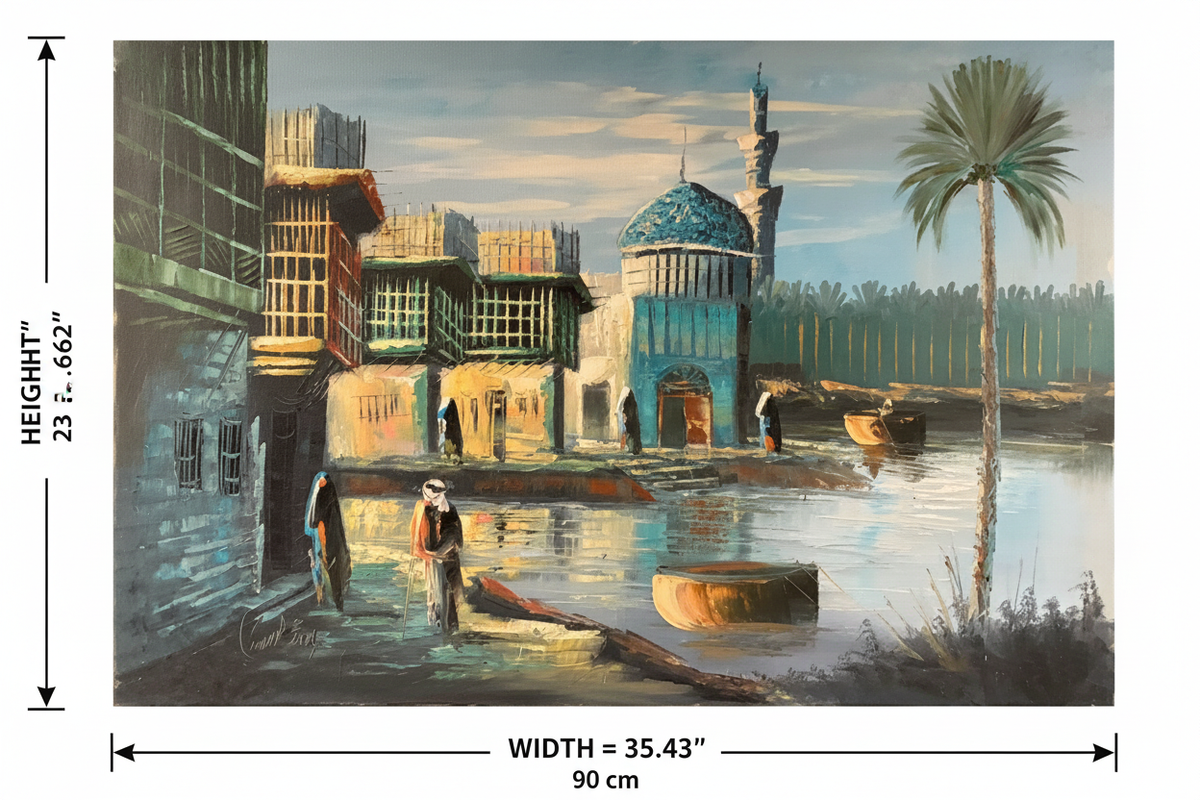
The river moves slow and cool through the old quarter, its surface carrying the reflection of everything that has ever mattered here. On the left bank, traditional multi-story buildings rise — their facades layered with wooden reed mashrabiya screens and lattice balconies built for shade and privacy, warm golden stone beneath the woodwork catching the soft afternoon light. Two figures stand at the water’s edge in traditional garments, unhurried. A round quffa — the ancient circular basket boat unique to the rivers of Iraq — bobs gently on the water beside a long wooden skiff. Behind the old buildings, the turquoise-tiled dome of a mosque rises above everything, its slender minaret reaching toward a wide, soft blue-grey sky. On the right, a solitary date palm stands tall over the riverbank, and in the far distance, a dense green grove of palms lines the opposite shore. This is The River Quarter — a painting of a place, a people, and a way of life of extraordinary depth and beauty.
This is an original, signed, hand-painted oil on canvas. It can never be exactly recreated.
This painting captures the living heritage of the rivers of Iraq — the Tigris and Euphrates, the cradle of civilisation. The quffa basket boat is one of the oldest watercraft in human history, used on these rivers for thousands of years. The mashrabiya screens, the mosque architecture, the palm groves — each element is a thread in the cultural fabric of Mesopotamia and the broader Arab world. This is not just a painting. It is a document of civilisation.
The deep teal, turquoise and warm golden tones of this painting command attention and bring cultural depth to any interior. Display it on a wooden artist’s easel as a heritage centrepiece, hang it as the focal point of a living room, study, or dining room, or use it to anchor a Middle Eastern or travel-themed gallery wall. The teal and ochre palette pairs beautifully with ivory, cream, deep navy, warm wood, and brass interiors.
The surface of this painting carries the physical mark of the artist’s hand in every stroke — the impasto texture of the mashrabiya screens, the movement in the water, the depth of the mosque dome’s tiled surface. These qualities exist in the paint itself, not in a file. No print can replicate them. An original oil painting holds cultural and monetary value that grows over time.
One painting. One river. One civilisation. Yours forever, if you act now.


